
Measuring Investment Risk

How risky are your bets?

Measure risk with tools like standard deviation, beta, and VaR.

Why Measure Investment Risk? 

Investors need clear insights into portfolio volatility and how individual assets respond to various market conditions. 

Measuring risk allows investors to align their holdings with personal risk tolerance and long-term financial objectives. 

It also reveals how fluctuations in returns may impact the likelihood of achieving goals, helping investors prepare for potential challenges while maintaining a strategic, informed approach to portfolio management.
Standard Deviation (Volatility Indicator) 

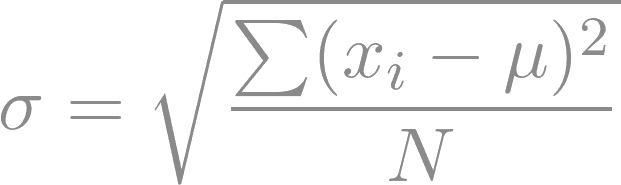
Standard deviation measures the variability of an investment’s returns relative to its average. 

Higher values indicate greater volatility and risk, with significant return fluctuations, while lower values suggest stability. 

For instance, a 15% standard deviation shows moderate variability, whereas 30% reflects much higher risk. 

Widely used in finance, it assesses asset or portfolio risk, with larger values often linked to greater uncertainty and potential for loss or gain.

Breaking Down Standard Deviation

standard deviation formula.png

σ | sigma – Population standard deviation: average distance of values from μ. Big σ → wide spread, volatile data over time; small σ → tight, stable set.
N – Population size, total values considered. Dividing by N (not N − 1) yields the exact dispersion for the whole population.
xᵢ – i-th value. Squared deviation (xᵢ − μ)² cancels sign and magnifies large outliers before summation, driving variance.
μ – Population mean, the central point around which deviations balance.

Jane Tackles Volatility 

After TechSpark’s unpredictable price swings rattled her portfolio, Jane analyzed its standard deviation and discovered it nearly doubled her overall volatility. 

Alarmed, she sold half her stake and shifted $2,000 into CitySafe Bonds, seeking stability. 

The adjustment steadied her portfolio, and when the market dipped later, Jane appreciated the foresight. 

The bonds provided a steadying anchor, balancing her exposure and proving the value of strategic reallocation.

Beta (Market Correlation) 

Beta quantifies an asset’s responsiveness to market movements, serving as a measure of market risk. 

A beta of 1 indicates the asset moves proportionally with the market. 

Values above 1 represent higher volatility relative to the market, while values below 1 denote reduced sensitivity. 

Beta helps evaluate how changes in overall market conditions may affect an asset’s return, offering insight into its relative risk compared to broader market trends.

Do you want to learn more?
Download InvestMentor to access the full lesson and explore interactive courses that build your financial knowledge and guide you toward smarter investing decisions.