Systematic Investment Risks

Risks you can't escape

Manage market-wide risks with diversification and smart strategy.

19-09.png

Introduction to Systematic Risks

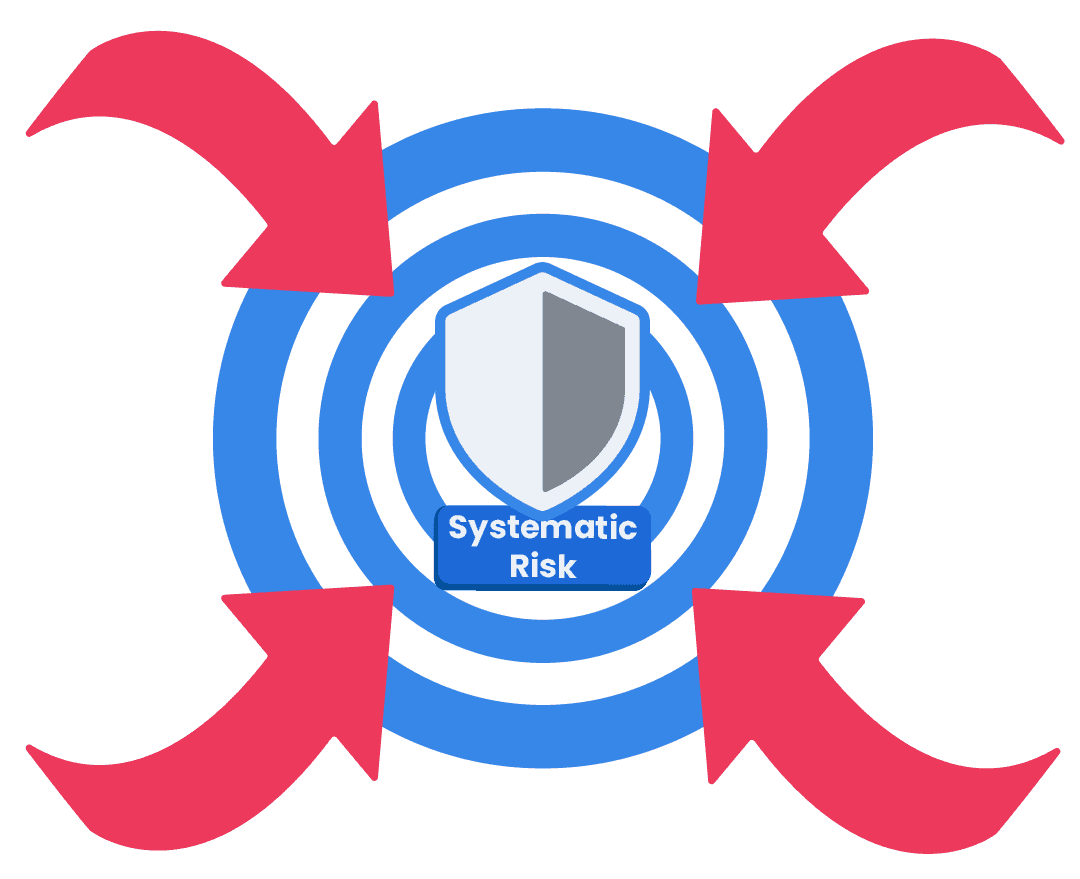
Systematic risk, also known as market risk, is the risk of negative impacts across an entire market or asset class due to broad economic, geopolitical, or financial factors. 

These include interest rate changes, economic recessions, and geopolitical tensions. 

Unlike risks associated with individual securities, systematic risk cannot be completely avoided through diversification. 

However, there are strategies available to help mitigate its overall impact on a portfolio.

Common Sources of Systematic Risk 

Systematic risk arises from factors like economic recessions, political instability, significant interest rate changes, or widespread inflation. 

These broad conditions impact nearly all asset classes simultaneously, leading to widespread declines in value. 

By understanding the sources of systematic risk, investors can better anticipate market-wide disruptions and create strategies—such as hedging, asset allocation, and long-term planning—to mitigate potential losses and strengthen portfolio resilience.

19-10.png

Systemic Risks in the Real World 

The 2008 financial crisis demonstrated the far-reaching impact of systemic investment risks. 

Originating with the collapse of the U.S. housing market, the crisis spread across global financial systems due to excessive leverage, widespread use of high-risk mortgage-backed securities, and insufficient regulatory oversight. 

These factors combined to create vulnerabilities that triggered widespread failures in banks and financial institutions, leading to global economic instability.

The Role of Asset Allocation 

Asset allocation involves dividing investments among various asset classes, such as stocks, bonds, real estate, and cash, to manage systematic risk. 

Different asset classes react uniquely to economic changes; for example, bonds may perform well when stocks decline. 

This strategy aims to balance the impact of economic shifts across the portfolio. 

While asset allocation cannot eliminate market-wide risks, it reduces reliance on any single asset class, thereby smoothing overall portfolio performance.

19-11.png

Jane Learns the Importance of Asset Allocation  

The memory of her dad’s struggles during 2008 drove Jane’s focus on stability. Allocating $5,000 to equities, $3,000 to bonds, $2,000 to a real estate ETF, and $1,000 in savings, she aimed to build resilience. 

When a global economic slump hit, her equities tumbled 15%, but bonds and property ETFs cushioned the fall. Her dad’s voice echoed, “Prepare for the storm before it arrives.” 

The balanced allocation reaffirmed that systematic risks require diversified defenses.

Do you want to learn more?
Download InvestMentor to access the full lesson and explore interactive courses that build your financial knowledge and guide you toward smarter investing decisions.