Trading Strategies and Risk Management

Plan your trades and protect your capital

Learn to trade currencies with purpose. Make smart decisions using strategy, risk control, and discipline.

From Curiosity to Control 

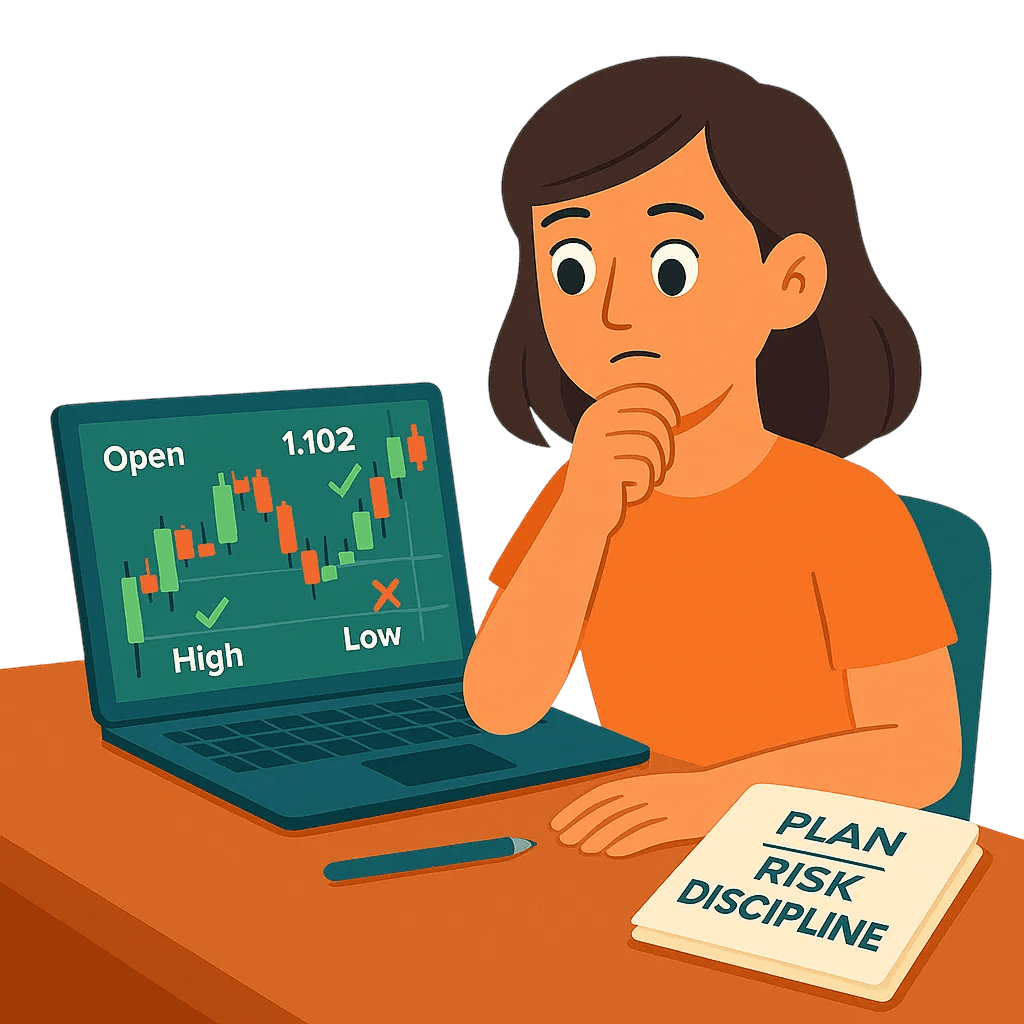
Anika’s Forex demo account has become part of her daily routine. She has a few wins under her belt, but some losses too. 

I can spot patterns,” she says, “but I still don’t know when to act.” 

That’s when it hits her: trading isn’t about luck, instinct, or impulse. It’s about strategy

Professionals don’t rely on hunches; they have a repeatable plan. 

They define their entry and exit points ahead of time, limit their risk per trade, and always trade with intention.
ChatGPT Image Nov 12, 2025, 02_02_23 PM (1).png

Every Trader Needs a Plan 

A trading plan is more than a checklist — it's your blueprint for decision-making under pressure. It guides what to consider before, during, and after a trade, helping you stay focused when emotions run high or markets move fast.   

A good plan will likely answer at least these questions: 

  • When can I enter a trade? What conditions need to be in place?
  • When can I exit? How will I know if I’m wrong or right?
  • How much can I risk? What percentage of my capital is on the line?

Managing the Downside 

The first rule of trading isn’t winning — it’s protecting your capital. Large, unmanaged losses can drain your account fast. 

That’s why many traders use stop-loss orders: automatic instructions that close a position if losses become too big. 

Anika buys EUR/USD at 1.1000 and sets a stop-loss at 1.0950.  

If the euro falls below 1.0950 dollars, her trading platform exits automatically, limiting the loss to 50 pips. 

Anika realizes: “It’s like a firewall. You use it to prevent a small problem becoming a disaster.”

Consider How Much Money to Risk 

Next comes the question of how much money to risk per trade — a key part of managing capital effectively. 

A common practice is to risk no more than 1–2% of your account on a single trade. For example, with a £5,000 account, that means risking between £50 and £100 per trade.  

Anika decides to adjust her trade sizes depending on volatility: 

  • Smaller sizes for fast-moving pairs.
  • Slightly larger sizes for calmer, more stable pairs.

Using smart position-sizing helps her to limit her losses.

Setting Take-Profit Targets 

Winning trades needs an exit plan too. 

Together with stop-loss orders, Anika starts using take-profit orders — automatic instructions to close a trade once her goal is reached. 

If she buys GBP/JPY at 205.00, she might set her take-profit at 206.00 and her stop-loss at 204.50

That means she risks 50 pips to aim for 100. It’s a two-to-one reward-to-risk ratio, a common standard among disciplined traders. 

Anika thinks:It feels good knowing where to stop. Not just gamble that the market keeps going my way.

Do you want to learn more?
Download InvestMentor to access the full lesson and explore interactive courses that build your financial knowledge and guide you toward smarter investing decisions.