
Government & Municipal Bonds

Backing governments for profit.

Secure stable income with safe, tax-advantaged gov bonds.

04-09.png

Introduction 

Government and municipal bonds are debt securities issued by federal, state, and local governments to fund public projects and operations. 

Known for their low-risk profiles and potential tax benefits, these bonds appeal to conservative investors like Carlos who prioritize capital preservation and steady income. 

After enhancing his portfolio with corporate bonds, Carlos seeks additional ways to increase stability and tax efficiency. In this lesson, we'll follow his journey.

Government Bonds for Stability 

Government bonds, such as U.S. Treasury securities, are backed by the full faith and credit of the issuing government, making them among the safest investments available. 

They provide regular interest payments and return the principal at maturity. 

Due to their low default risk, government bonds typically offer lower yields compared to corporate bonds. 

These bonds are ideal for investors who prioritize capital preservation and prefer a dependable income stream  rather than higher returns.

Government Bonds by Maturity 

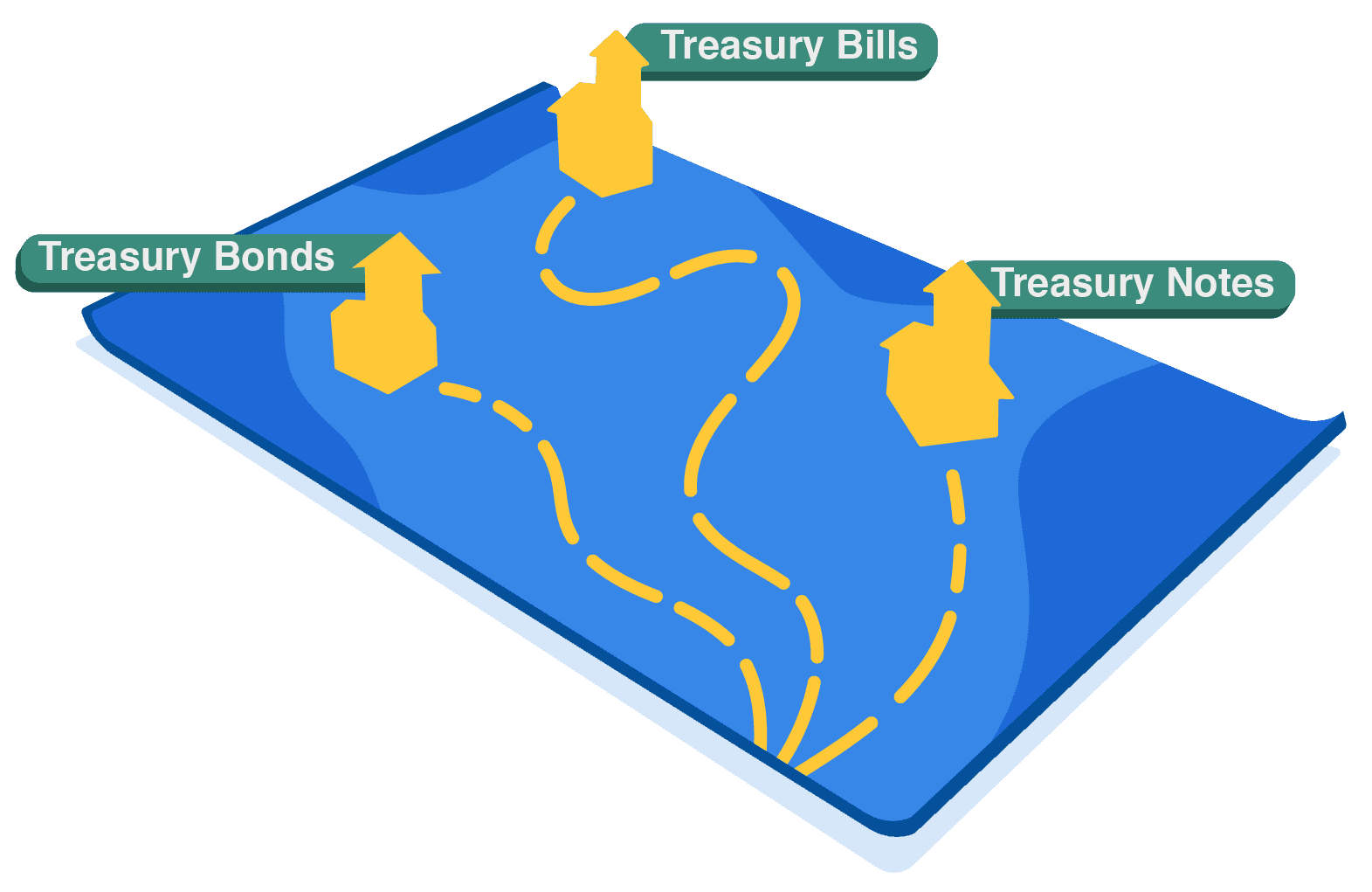
Government bonds are categorized by their maturity lengths. 

In the US, Treasury Bills, or T-Bills, are short-term securities maturing in one year or less, sold at a discount and redeemed at face value upon maturity. 

Treasury Notes, known as T-Notes, have medium-term maturities ranging from 2 to 10 years and pay interest semi-annually. 

Treasury Bonds, or T-Bonds, are long-term securities maturing in over 10 years, also offering semi-annual interest payments.

Carlos Buys Government Bonds 

To strengthen the security of his investments, Carlos allocates $50,000 to U.S. Treasury bonds. 

He purchases ten 10-year Treasury bonds with a face value of $5,000 each, offering a 2% annual coupon rate paid semi-annually. 

Carlos appreciates that these bonds are backed by the U.S. government, providing peace of mind. 

The regular interest payments of $1,000 per year help him maintain a steady income stream, while the return of principal at maturity safeguards his capital for future needs.

Municipal Bonds and Tax Benefits 

State and local governments issue municipal bonds to fund public projects like schools, highways, and hospitals. 

A key attraction of municipal bonds is their tax benefits: the interest earned is often exempt from federal income tax and may also be exempt from state and local taxes if the investor resides in the issuing state. 

This tax-exempt status makes them appealing to investors seeking efficient income in higher tax brackets. 

They help investors support community development while benefiting financially.

Do you want to learn more?
Download InvestMentor to access the full lesson and explore interactive courses that build your financial knowledge and guide you toward smarter investing decisions.