
IBKR InvestMentor
HomeNewsCoursesSnapshotsVideos
Privacy & TermsSocial Media DisclosureCookie settings

2026 Interactive Academy. All rights reserved.
IBKR InvestMentorSM is owned by Interactive Academy LLC, an affiliate of Interactive Brokers LLC. All content provided by IBKR InvestMentorSM is for informational and educational purposes only and should not be interpreted as implying any sponsorship, partnership, endorsement, recommendation, or approval by Interactive Brokers LLC or its affiliates.
  1. Courses
  2. Microeconomics
  3. Imperfect Competition

Imperfect Competition

When Competition Isn’t Perfect

Most real-world markets don’t look much like perfect competition. Products differ, some businesses are bigger than others, some excel at branding, and new rivals can face obstacles to entering the market.

Economists group these markets under imperfect competition. Here, businesses may have some power to set their own prices because customers see differences between products or have fewer alternatives.

How much power firms have varies widely, giving rise to different market structures, from oligopolies and monopolies to monopsonies.

One Seller Ruling the Market

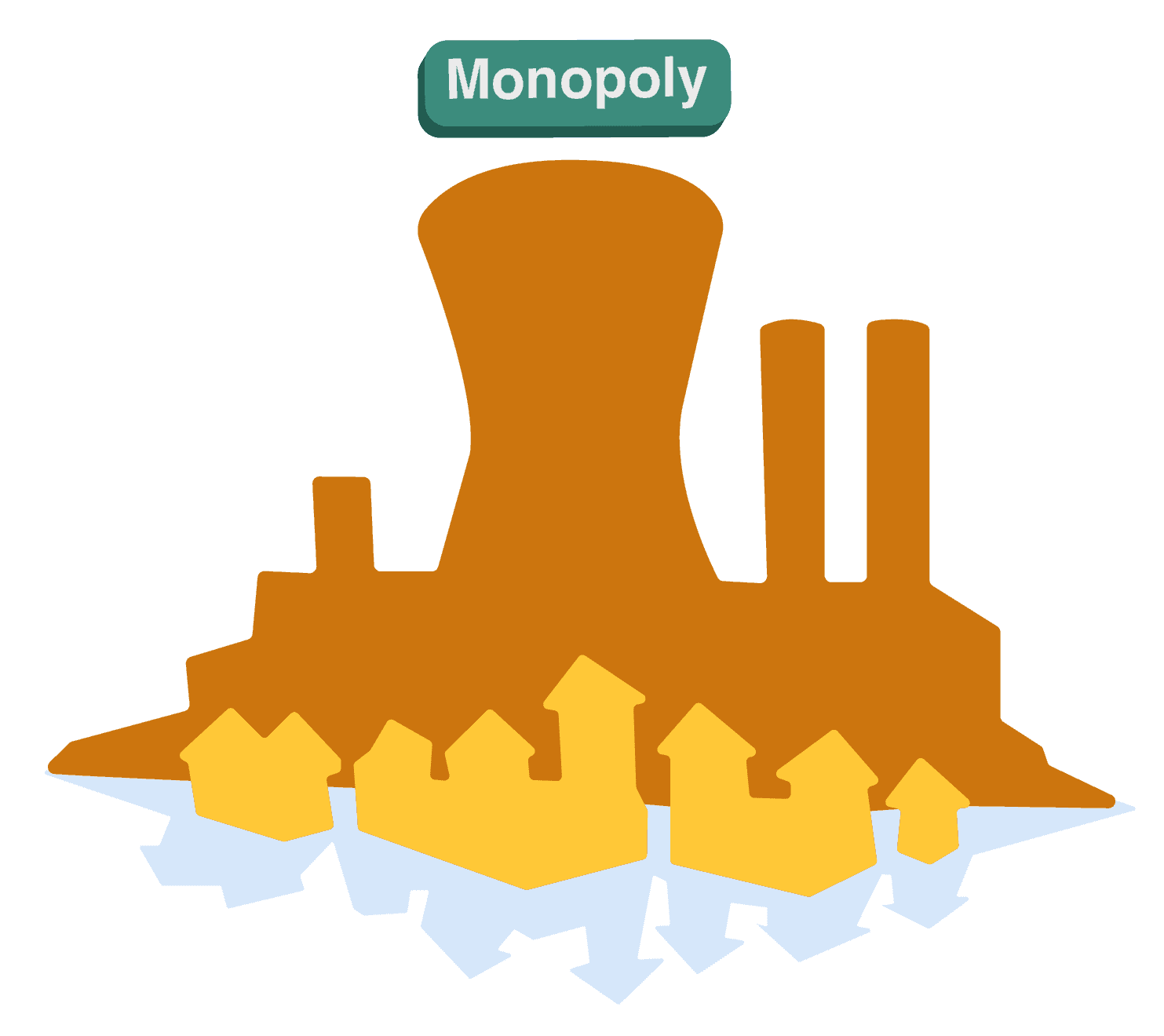
A monopoly exists when a single supplier controls a market and rivals face major barriers to entering it. Those barriers might include huge start-up costs, control of a key resource, patents, or legal restrictions.

Adam encounters this at Cool Scoops: the city owns all the trading pitches in the park, so it’s his only option if he wants to set his ice-cream stall there. If the city raises his pitch fee, there’s no rival park landlord offering him a better deal.

That’s the power of a monopoly: without direct competitors, a supplier can have considerable power over prices and availability.

Natural Monopoly

Some industries have such high fixed costs that it’s cheaper for one large provider to serve everyone than for several competing firms to build the same infrastructure. Economists call this a natural monopoly.

Think about the water supply of Cool Scoops. Building one network of pipes across the city is expensive. Building several rival networks would mean multiplying those costs several times over.

As one provider serves more customers, its average cost can fall, creating economies of scale. But with consumers unable to switch providers easily, natural monopolies are usually regulated by governments to limit their market power.

The Power of Few 

Milk available to Cool Scoops comes from just three large dairy suppliers — two agricultural giants and one cooperative of small farms. Adam has some choice, but less than he would in a market packed with competing dairies.

That’s an oligopoly: a market dominated by a small number of large players. Their decisions are interdependent. If one cuts milk prices or invests in new milking robots, the others must decide how to respond.

This strategic rivalry can spur investment, but limited competition can also contribute to higher prices or restricted supply. Firms may even conspire to fix prices or divide markets, although such agreements are usually illegal.

One Buyer Calling the Shots

A monopsony is a market with only one buyer. With sellers having nowhere else to take their business, that buyer can gain considerable power over the price it pays.

A typical example would be a remote mining town where one big company employs almost everyone and controls the local economy. With few alternative employers nearby, workers have less bargaining power over wages and working conditions. Local small businesses and housing markets are dependent on the mining firm, too.

Monopsony can also appear in product markets, where a dominant buyer, like a national health care provider, pushes down the prices paid to suppliers.

Do you want to learn more?
Download IBKR InvestMentor to access the full lesson and explore interactive courses that build your financial knowledge and guide you toward smarter investing decisions.
Log in to access the full lesson
or