Option Greeks I.

Math behind options moves.

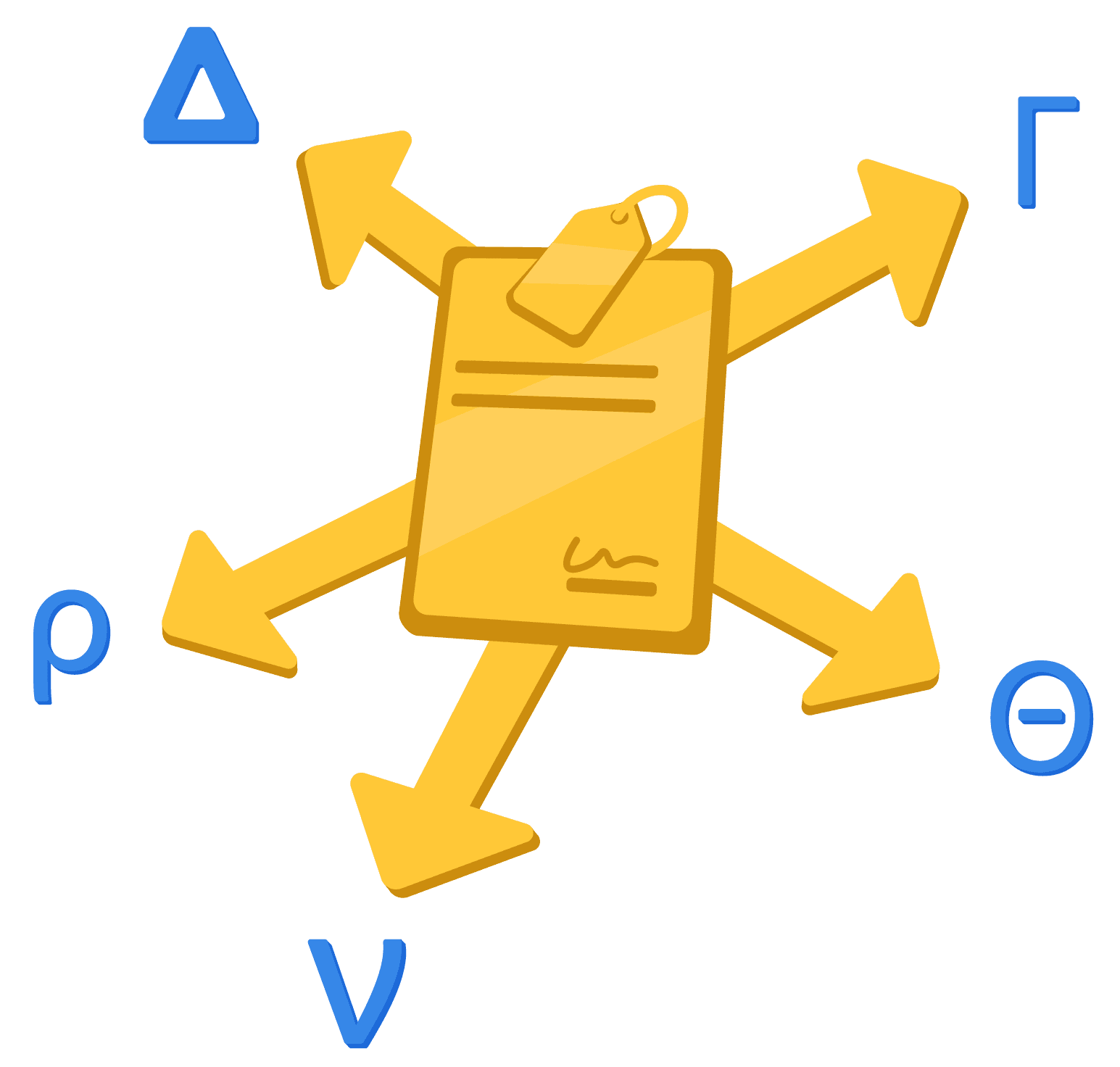
Master Delta & Gamma: predict option moves, probability, & risk.

07-16.png

 Introduction to Option Greeks 

Option Greeks are financial metrics that describe how the price of an option changes in response to different factors. 

They are essential tools for understanding and managing the risks associated with options trading. 

The primary Greeks include Delta, Gamma, Theta, Vega, and Rho. Delilah, seeking to deepen her options trading skills, realizes that mastering the Greeks is crucial for predicting option price movements and making informed decisions.
07-17.png

Understanding Delta 

Delta represents how much an option's price is expected to change for a $1 change in the underlying asset's price. 

It ranges from 0 to 1 for call options and from -1 to 0 for put options. 

For example, a call option with a delta of 0.5 suggests that the option's price will increase by $0.50 if the stock price rises by $1. 

Delta reflects the option's sensitivity to price movements and indicates how closely the option's price follows the underlying asset.

Delilah Analyzes Delta  

Delilah eagerly studies her AllTheThings Inc. call option with a delta of 0.6. This tells her that for every $1 increase in AllTheThings Inc.'s stock price, her option value will rise by $0.60 per share, translating to $60 for the 100-share contract. 

AllTheThings Inc. is set to release quarterly earnings, and market chatter predicts a $5 surge in the stock price. 

Delilah calculates her potential gain as $0.60 × $5 × 100 = $300. Visualizing this scenario boosts her confidence as she holds the position firmly.

Delta as Probability Indicator 

Delta can also be viewed as an estimate of the probability that an option will expire in-the-money. 

For example, a call option with a delta of 0.6 suggests a 60% chance of having value at expiration. 

While not precise, this interpretation offers a useful guideline for assessing the likelihood of success. 

Considering delta as a probability helps investors evaluate trades based on their risk tolerance, expected market trends, and confidence in their analysis.

07-18.png

Understanding Gamma 

Gamma measures the rate of change of delta in response to a $1 change in the underlying asset's price. It indicates how much the delta will change as the asset's price moves. 

A high gamma means delta is very sensitive to price changes, leading to larger swings in the option's value. 

Gamma is highest for at-the-money options and decreases for options that are deep in- or out-of-the-money. 

Understanding gamma helps traders anticipate how delta will evolve with market movements.

Do you want to learn more?
Download InvestMentor to access the full lesson and explore interactive courses that build your financial knowledge and guide you toward smarter investing decisions.