
Media
Earnings Drop🎥
10/13/2026
10/14/2026
One of the most important links in the AI supply chain, Dutch company ASML, kicked off the earnings season with a blockbuster quarterly report. It nudged up its sales forecast more than analysts expected, despite struggling to fulfill the orders.
ASML said demand for its chipmaking machines will exceed its production capacity through at least 2028. Customers are already asking about orders for 2029 and even 2030, signaling that chipmakers expect AI spending to remain enormous for years.
Quarterly highlights:
When people talk about the AI boom, they usually focus on Nvidia's chips or Anthropic’s and OpenAI’s chatbots. Dig a little deeper and you get to TSMC, the Taiwanese chip foundry that manufactures Nvidia’s products. Then there are the memory chip makers: Micron, SK Hynix, and Samsung — crucial in powering the AI chips.
But all the links in the AI supply chain need ASML. It’s the world's only commercial producer of extreme ultraviolet (EUV) lithography machines, which are used to print microscopic patterns on chips. They are engineering monsters, size of a bus, containing more than 100,000 parts and requiring decades of research to develop. The most advanced of these machines can cost up to $400 million.
TSMC, Samsung, Micron, Intel, SK Hynix are all customers of ASML. No other company can currently provide equivalent technology.
AI infrastructure spending is set to exceed one trillion dollars this year, according to Goldman Sachs. Hyperscalers like Alphabet, Microsoft, Amazon, and Meta are racing to buy more computing power and build data centers.
But there are speedbumps:
ASML’s crucial role in the supply chain is why investors are so keenly following its production capacity. The chip crunch will ease only if there’s enough high-end machinery available.
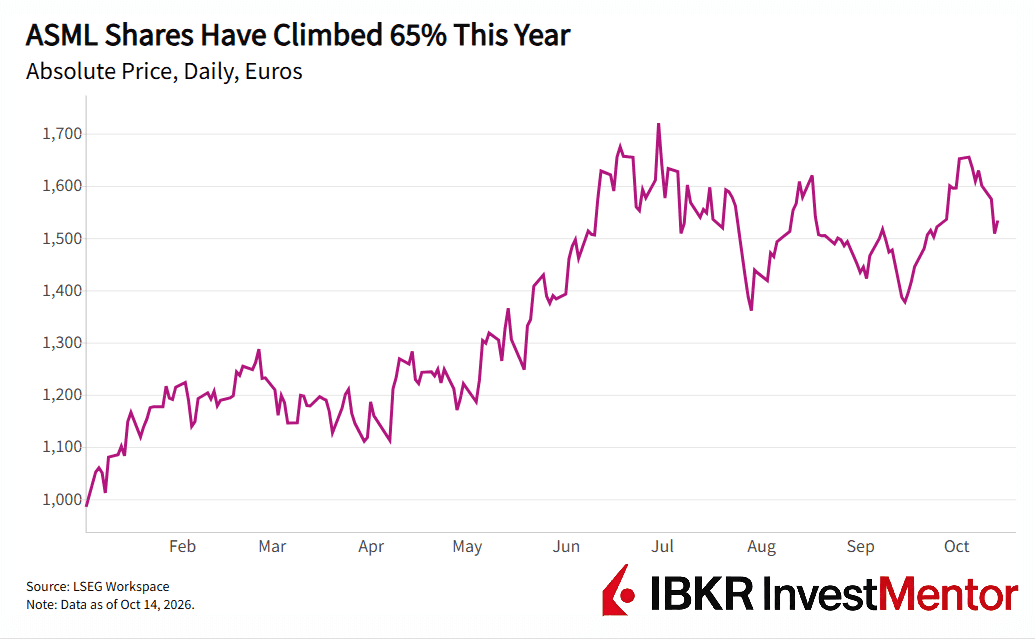
ASML is trying to counter the overwhelming demand by building more capacity. With a €600 billion market cap, it is already Europe’s most valuable company. The faster it can respond to the AI boom, more money there is to be made.
Earlier this year, it announced plans to increase production capacity by 30% in 2027 and another 30% in 2028. Now, CEO Christophe Fouquet says that’s not enough. The company is exploring further expansion, upgrading customers' existing tools, and producing faster versions of its machines.
It has also begun a major expansion project in the Dutch city of Eindhoven, although that won't be completed until 2029.