Markets
Alternative Paths
Looking Beyond Stocks and Bonds
8/11/20268/17/2026

After failed attempts in New York and London, online fast-fashion firm Shein is finally preparing to list its shares in Hong Kong on 1 September. The initial public offering (IPO) launches after the company got a green light from Chinese securities regulators, with the company expected to issue up to 8% of its shares and raise $1.7 billion.
What should have been a routine stock market debut has become a four-year geopolitical obstacle course.
US lawmakers raised concerns about Shein's supply chain, while UK and Chinese regulators clashed over how the company described these risks. Beijing was also unhappy with Shein's efforts to present itself as a Singapore-based global company. The company was founded in China but moved its headquarters to Singapore in 2022.
The timing is awkward. Shein just reported nearly a $100 million loss in the first quarter of 2026, while annual profit slumped from $3.4 billion in 2024 to $2 billion in 2025. Regulatory scrutiny, rising customs duties, and intense competition have slashed Shein’s valuation by more than $70 billion over the past few years:
Investors are discounting for slower growth and thinner margins, which were never that great to begin with: Shein’s profit margin fell from 8.7% in 2024 to 4.9% in 2025. Shein is raising prices, but in doing so, risks losing customers.
Shein built its advantage by flying individual orders directly from Chinese factories to Western shoppers. In the US, the de minimis rule allowed packages worth less than $800 to enter duty-free. That helped make a $5 dress economically possible.
Washington ended the exemption for Chinese shipments in May 2025. Shein’s sales slowed, its US revenue share fell from 30% in 2023 to 22% in 2026. The EU followed, scrapping a long-standing €150 customs-duty exemption in July.
The UK is aiming to close a similar loophole by October 2028.
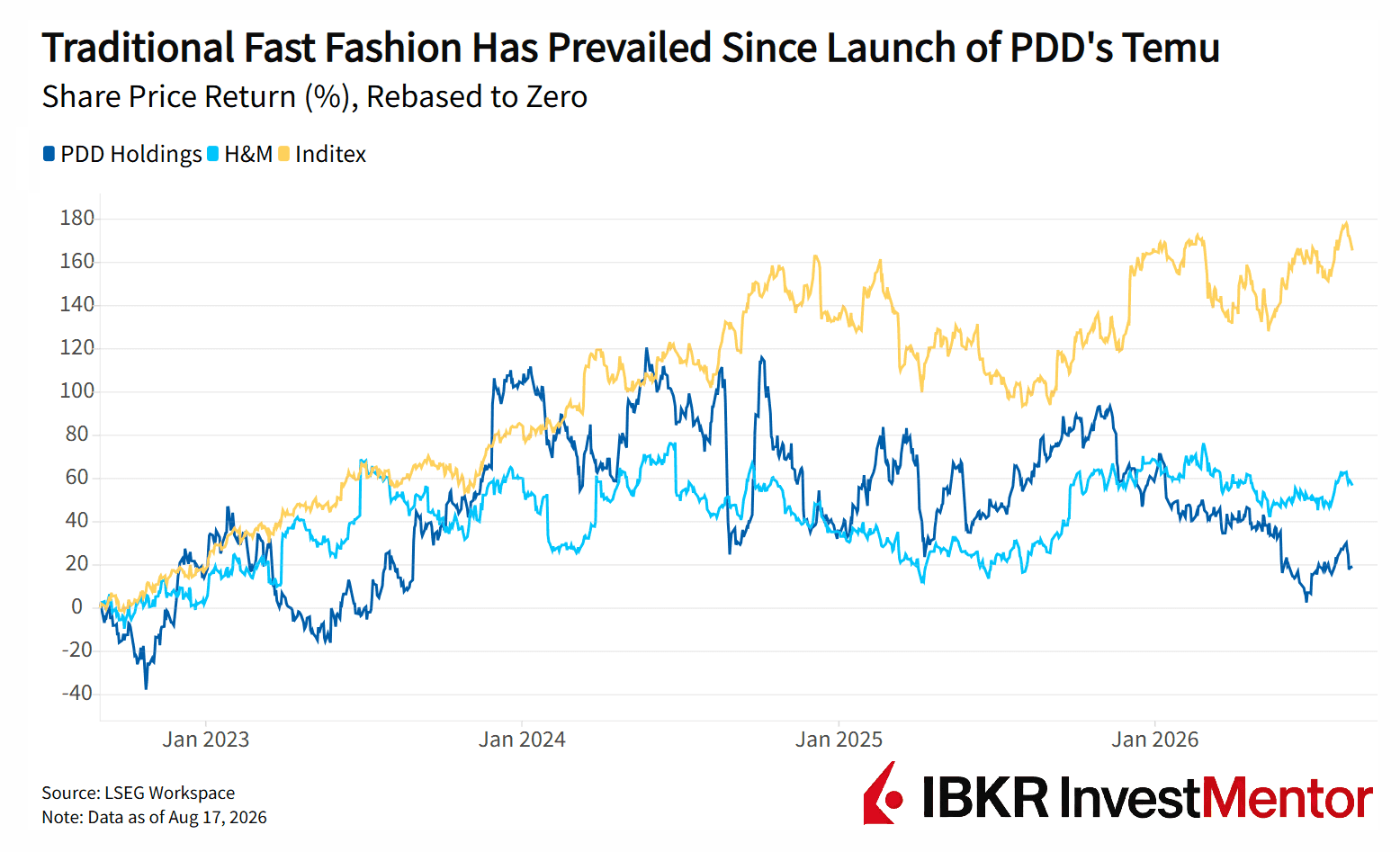
Shein’s fiercest fight is with Temu, launched by China’s PDD Holdings in 2022. Temu copied the direct-from-China formula but expanded it beyond clothing and gamified the shopping to the extreme with spin-to-win wheels and countdown timers. The pair belongs to a broader wave of Chinese commerce platforms moving overseas:
But traditional fast-fashion houses like H&M, Inditex’s Zara, and Fast Retailing’s Uniqlo are still holding the fort with their large store networks, stronger pricing power, and better relationships with regulators.
Want to explore more? Download our free app to unlock expert news updates and interactive lessons about the financial world.