Economy
Fed in Focus
The Federal Reserve’s Dual Mandate in Focus
12/9/202512/11/2025
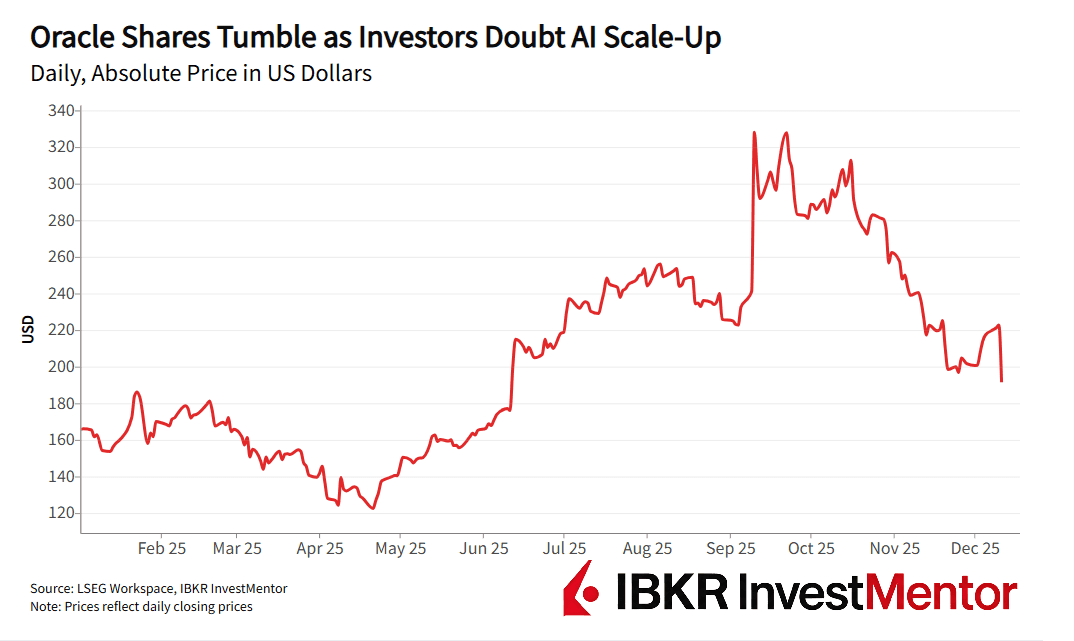
Oracle shares tanked as much as 14% on Thursday after the tech giant reported disappointing quarterly results. The sell‑off rippled across the AI sector, taking down many rivals too.
Other AI stocks like Nvidia, AMD, Micron, CoreWeave, and Broadcom (just before reporting earnings) saw 2-5% drops in share price.
The reaction shows how tightly the AI trade is now wired together. Investors weren’t just reacting to one quarter of a single company, but to the growing tension between rapid AI expansion and the rising financial strain required to fund it.
Oracle easily beat expectations on profit, but with revenue at $16.06 billion, it slightly missed the $16.21 billion consensus forecast by analysts.
Full‑year capital expenditures jumped to about $50 billion, up from $35 billion in September, spooking investors who were already worried about Oracle’s spending — especially after the issuance of $18 billion jumbo bond back in September. Negative free cash flow and soft guidance didn’t help either.
Investors expect near-perfection from AI stocks with sky-high valuations.
A major source of investor unease is Oracle’s deep reliance on OpenAI, which represents a huge share of its $523 billion future contracts.
Oracle shares surged 36% back in September when the company announced a $300 billion cloud-computing contract with the ChatGPT developer, spanning across five years.
OpenAI’s own spending plans are enormous and increasingly scrutinized, yet because it’s not listed on a stock exchange, investors are exposed to it via Oracle, Microsoft, Nvidia, and other public partners. So, when Oracle shares wobble, it’s a reflection on investor confidence in OpenAI almost as much as in Oracle itself.
Credit default swaps (CDS) are derivative contracts that protect lenders if a company can’t repay its debt. They can be used for both hedging and speculating. When CDS prices rise, it's usually because investors see a higher risk in that company’s balance sheet.
Oracle’s CDSs have jumped to record highs as the firm borrows heavily to fund AI data‑center buildouts. That doesn’t mean a default is likely, but it shows the market is demanding a higher premium to hold the debt — a sign that its aggressive AI spending is impacting market perception.
Some of the other AI stocks, like CoreWeave, have also seen credit default swaps surging. Higher perceived credit risk can raise borrowing costs, squeeze cash flow, and limit strategic flexibility.
Credit default swaps were central to the 2008 financial crisis. Banks like Lehman Brothers and Bear Stearns had written huge amounts of CDSs on mortgage‑backed securities.
When rising interest rates triggered a wave of mortgage defaults, those securities collapsed, and CDS payouts ballooned. CDSs became a symbol of how hidden leverage and thin liquidity can amplify stress across the entire financial system.
Back then, the CDS market was vast, opaque, and lightly regulated. These days, there's more transparency in the market. Regulators have pushed through central clearing, mandatory trade reporting, and more standardized contracts.
Want to explore more? Download our free app to unlock expert news updates and interactive lessons about the financial world.