
Tech
AI Advantage
Comparative Advantage Through the AI Lens
11/12/202511/13/2025
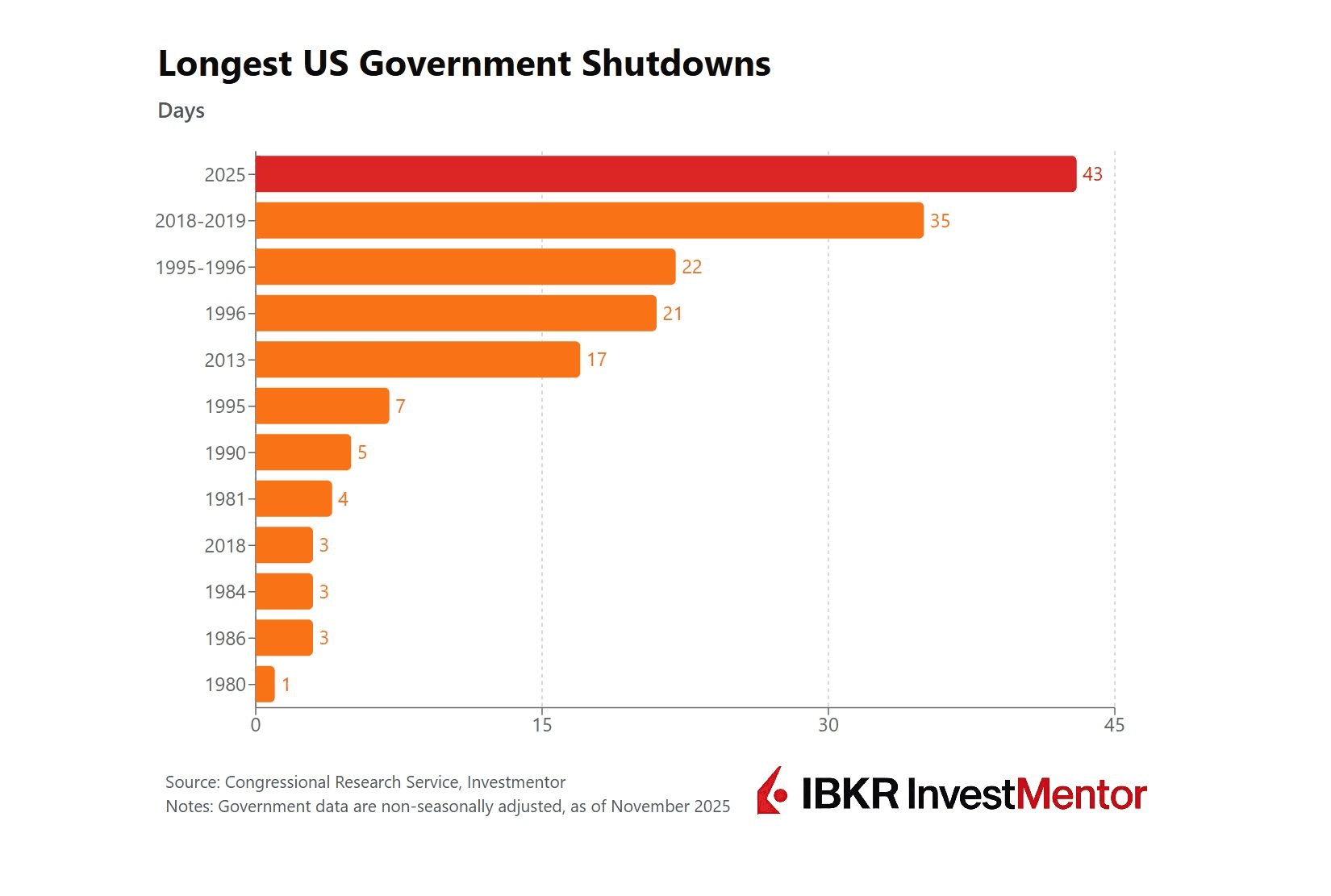
The longest government shutdown in US history is officially over. Late Wednesday, President Donald Trump signed a funding bill after the House passed it 222–209, restoring pay for federal workers and restarting suspended services.
The deal doesn't resolve bigger issues of political gridlock and rising debt.
The shutdown suspended services across the US, and more than one million federal employees went six weeks without pay.
The Congressional Budget Office expects most of the economic damage will be recovered over the course of next year — assuming no further shutdowns.
Markets greeted the end of the shutdown with a shrug, with no discernible shift in the sentiment.
Equities had already priced in optimism earlier this week when signs of a deal emerged, but even that reaction was subdued. Wall Street is so numb to annual budget standoffs that even a record-breaking one barely registers. To investors, Washington is noise, not a signal.
The real source of volatility lately? Tech stock valuations.
From a market perspective, the biggest issue is the data blackout. The Federal Reserve is navigating a critical period without its usual economic compass.
According to the White House, October’s inflation and jobs reports will likely not be released. Economists are urging the Labor Department to fast-track November CPI and employment data to guide the Fed’s December rate decision.
The Fed is still broadly expected to cut the benchmark rate by 25 basis points to 3.50%-3.75% in its December meeting. But it may have to rely on September data and private estimates to make the call.
Most democracies have mechanisms in place to fund government services even if lawmakers struggle to agree on a budget. This used to apply to the US as well.
A 1980 Attorney General ruling reshaped the rules: federal agencies can’t spend without approved funding. That means each fiscal year, starting in October, brings the risk of a government shutdown.
Just like this time — lawmakers often come up with a stopgap measure that can keep the lights on temporarily. This “kicking the can” approach means multiple shutdowns in the same year are possible.
Want to explore more? Download our free app to unlock expert news updates and interactive lessons about the financial world.