
Chip Honeytrap
Spy Scandal Shakes Investor Confidence in AI Darling
11/10/2026
11/12/2026
Nvidia CEO and co-founder Jensen Huang has resigned effective immediately after reports of him having affairs with a suspected Chinese spy, Alice Huang (unrelated), and Nvidia’s vice-president of healthcare, Kimberly Powell. Nvidia’s chief financial officer Colette Kress will act as interim CEO until a permanent one is selected.
The exit sends shockwaves across the AI industry. Under Jensen Huang’s leadership, Nvidia did not only provide powerful chips required for the AI boom but also became a key financier of other major players including OpenAI, Anthropic, Intel, and numerous data center providers.
He has admitted being “unfaithful” to his wife in a press release: “My actions hurt her and our children. There is no excuse for what I did. I am deeply sorry.”
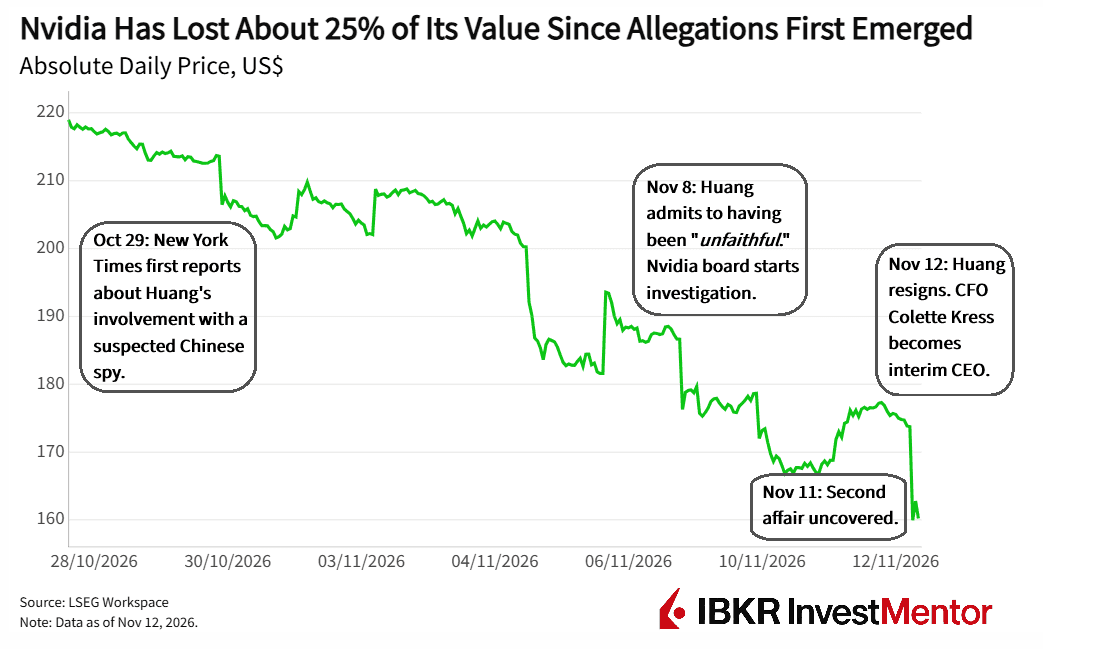
Never before has one man’s romantic entanglements caused such mayhem in the markets. By Thursday, Nvidia had lost 25% of its value since New York Times first reported on Huang’s involvement with a suspected Chinese spy on 29 October. It has shed about $1.3 trillion dollars of its market capitalization since then, and nearly two trillion compared to its all-time peak earlier in October.
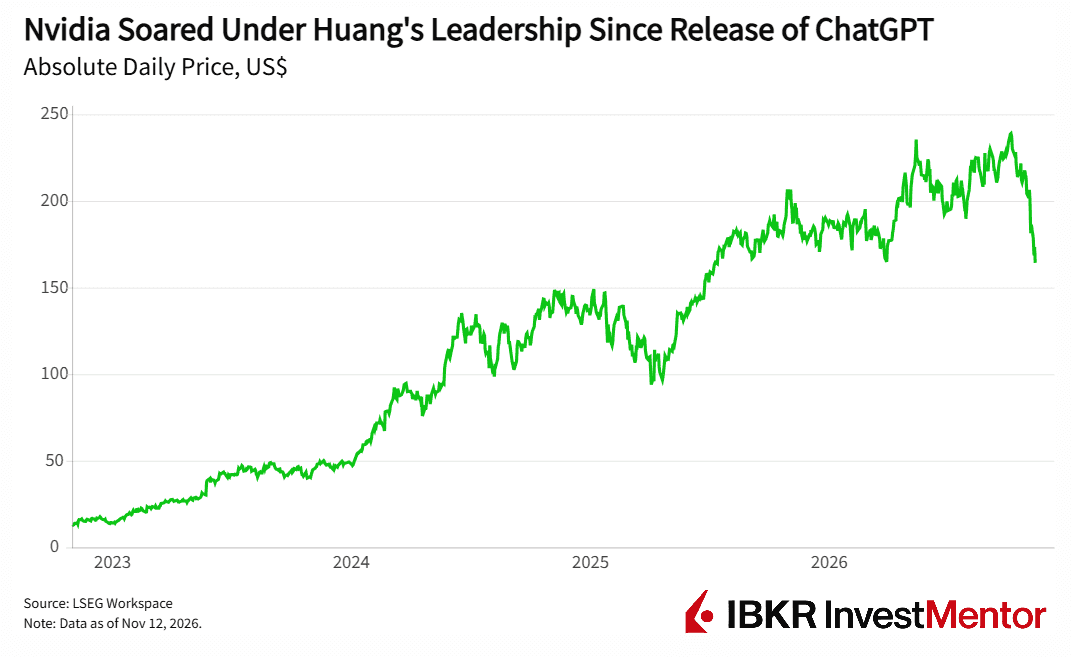
Nvidia’s key-person risk detonated, destroying some of the value Huang had created. He co-founded Nvidia in 1993 and has spent 33 years molding it into the world’s most valuable company (a position it has now lost).
Roughly 60 senior executives reported directly to Huang, and he never prepared a succession plan. Last month, he said in an interview he might lead the company two more decades.
While Jensen Huang’s exit will calm the furor around the chipmaker somewhat, Nvidia and its former CEO still have a lot of questions to answer. The board announced an inquiry earlier this week, done together with outside lawyers. US Congress has so far only issued a closed-door briefing request but a formal investigation is likely to follow.
The alleged spy Alice Huang got close to the Nvidia CEO as an executive of Megaspeed, a Singapore-based customer of the American chipmaker. The company reportedly helped to get over $7.5 billion worth of Nvidia chips to Chinese companies. The US suspects that at least some of these were smuggled directly to China, defying sanctions.
A short seller Christian Lamarco at Culper Research warned about Nvidia’s suspicious dealings with Alice Huang and Megaspeed already six months earlier, but the report went largely unnoticed.
A detail that didn’t get as much attention in Huang’s resignation announcement was the board shakeup.
During Huang’s 33-year reign, Nvidia has operated under an unusual structure. It had no board chair, and three directors out of 11 have been around since the 1990s. Only two new ones have been named since 2021. Huang himself was one of the directors.
Now, Nvidia is moving away from this to something more conventional. The board has named Harvey C. Jones as Nvidia’s first-ever chair. He is part of the old guard though and has served as a director since Nvidia was founded in 1993.
Jensen Huang lobbied for less stringent rules for chip exports to China, making the spy scandal particularly damaging. The US still restricts advanced AI chips over fears they could strengthen China’s military and AI capabilities. But President Donald Trump recently allowed Nvidia to sell its powerful H200 chips to approved buyers.
Trump was reportedly briefed about Huang’s involvement with a potential Chinese spy around a year ago but did not act on it and continued to associate with the Nvidia CEO.
China has warned the US not to use “fabricated espionage narratives” as a pretext for more tech restrictions.