Economy
Banking Sector
Markets Boom as Policy Risk Emerges
1/16/20261/19/2026

The White House has retreated from plans to slap additional 10% tariffs on select Nato allies on Feb 1, rising to 25% in June. President Donald Trump announced the punitive duties originally as a way to gain approval to buy Greenland, an autonomous territory of Denmark. But on Wednesday, the President said he and Nato Secratary General Mark Rutte have formed a “framework for a future deal with respect to Greenland and, in fact, the entire Arctic Region”.
The tariff threat lifted from:
All targeted countries had recently deployed a small number of troops to Greenland, angering Washington.
The White House U-turn came after the stock markets had their worst day in months, US treasury yields spiked, and the dollar took a beating. This time, the tariff threat was driven by territorial claims, rather than concerns about a trade imbalance. Investors were worried about a tit-for-tat trade war.
While US military action and the extra duties are scrapped for now, the details of the deal are vague. Nato does not have the authority to make deals about Danish territory. Secretary General Rutte said the deal would involve Nato allies taking a bigger role in Arctic security.
Early reports suggest that the US could gain permanent access to small parts of Greenland for military use, following the model of the UK's military bases in Cyprus. But any such deal would have to be accepted by both Denmark and Greenland. We're not out of the woods yet.
Before the tariffs were suspended, the EU leaders were reportedly preparing a two‑track response: keep talking, but ready the tools. This work will likely continue in the background, in case the White House renews its threats.
Potential responses by the EU:
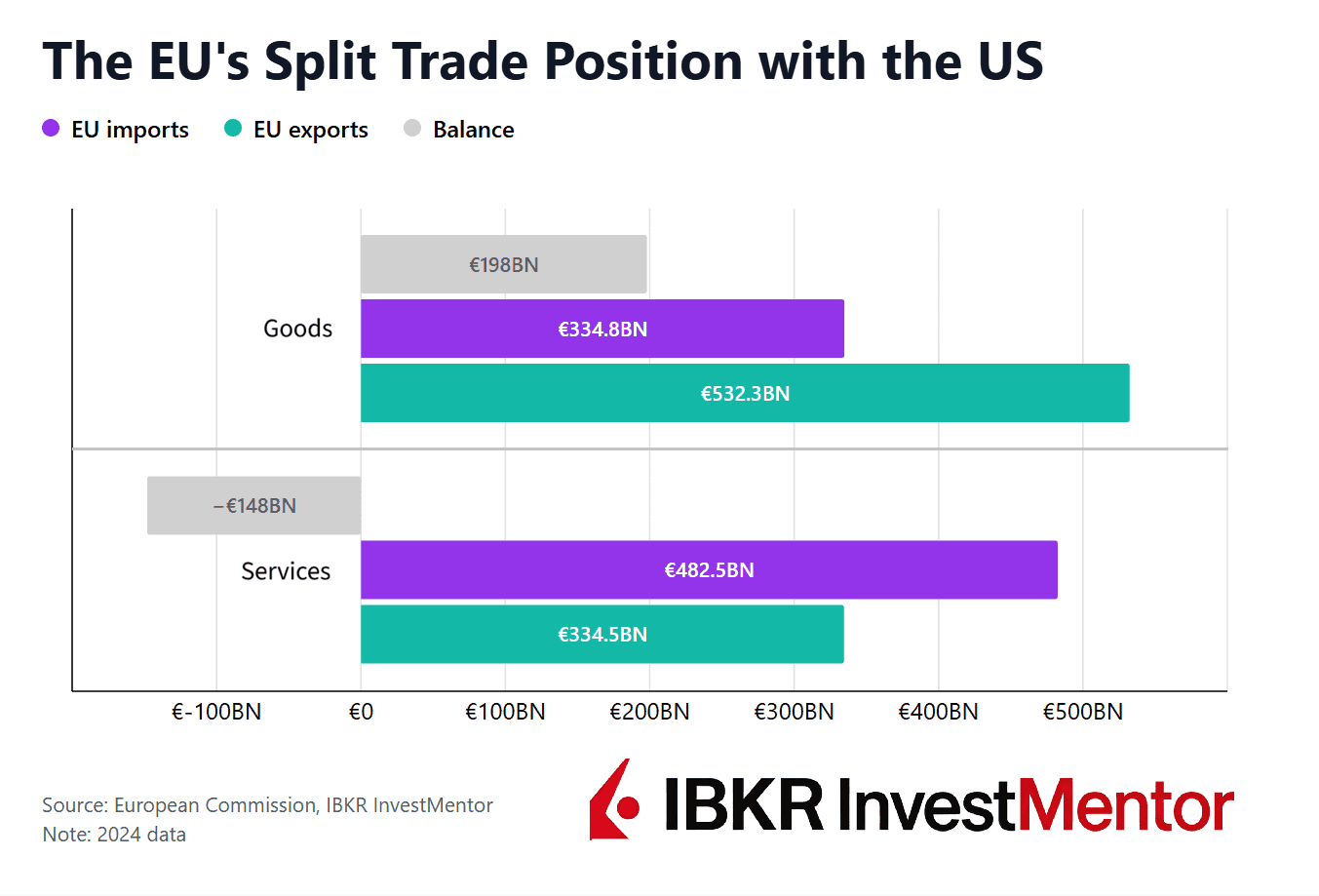
The latter could hurt American tech giants and other service providers. While the US has a trade deficit with the EU on goods, it runs a big surplus on services.
So, what are tariffs again? They are taxes on imported goods, paid by importers, not directly by foreign governments. The costs usually get passed along the chain to subcontractors, retailers, and ultimately consumers too.
Higher tariffs can mean higher prices, disrupted supply chains, and more uncertainty for businesses planning investment.
That’s why markets tend to react quickly to new tariff announcements: safe haven assets like the Swiss franc and gold may strengthen, while vulnerable sectors like cars, pharmaceuticals, luxury goods, and tech may suffer.
If the White House decides to return to the tariff plan, this will likely be challenged in court. They’re directly linked to the acquisition of Greenland and used as leverage for a US territorial claim.
The US Supreme Court is still mulling over its decision on the “Liberation Day” tariffs slapped on nearly all countries last year. That ruling could be out as early as this week. President Donald Trump relied on the International Emergency Economic Powers Act (IEEPA) to impose the previous tariffs, claiming they would bring back American factory jobs and flip the persistent US trade deficit into a surplus.
Many countries have since negotiated a lower base with the US. The EU got the rate down for its exports to 15%, in exchange for a 0% rate on the US goods. That deal is now put on hold in the European Parliament.
Want to explore more? Download our free app to unlock expert news updates and interactive lessons about the financial world.