Tech
Chips Don't Wow
Nvidia’s Blowout Quarter Fails to Impress Insatiable Investors
5/21/20265/21/2026
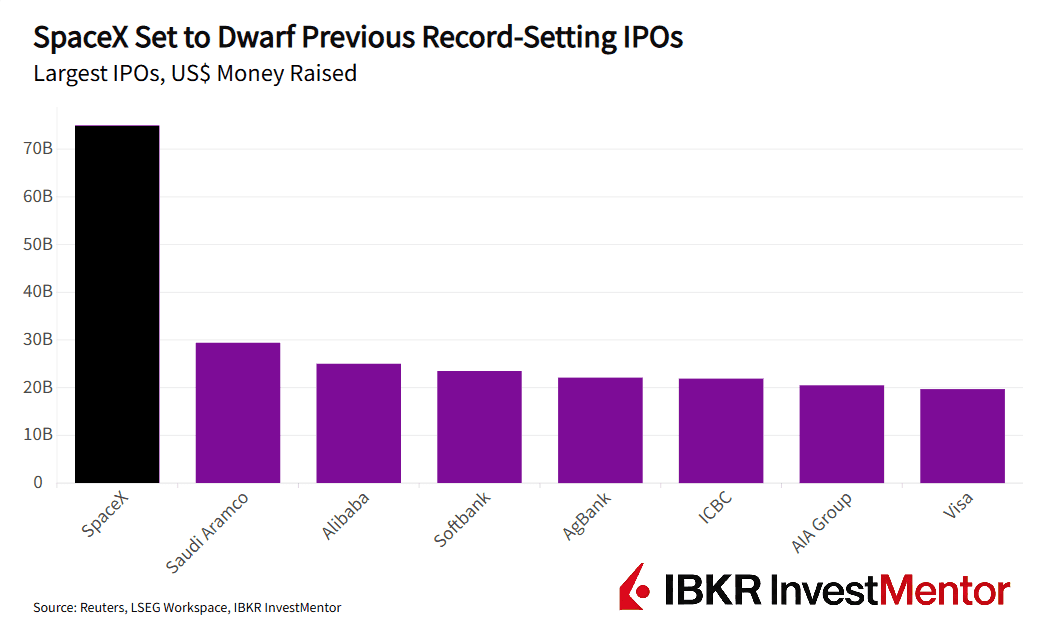
SpaceX is lining up the largest initial public offering (IPO) on record, hoping to raise about $75 billion at a valuation of $1.75 trillion. If successful, it would easily surpass Saudi Aramco’s 2019 record of $29 billion.
SpaceX is known as Tesla CEO Elon Musk’s rocket company, but it’s much more than that. It has three main businesses: rocket launches, satellite system Starlink, and AI unit xAI. The latter houses social media platform X (formerly Twitter) and controversial chatbot Grok, which has faced a lot of regulatory scrutiny.
The roadshow for the IPO is reportedly kicking off on June 8, with the listing expected soon after.
A prospectus is the document companies file before going public. It’s an instruction manual for investors before they buy shares. It should cover:
SpaceX’s version is over 270 pages + the appendix. It blends hard numbers with a mind-boggling vision of “multiplanetary” life involving asteroid mining, orbital data centers, and even a million-person colony on Mars.
SpaceX claims there could be “new trillion-dollar markets on the Moon, Mars, and beyond.” Investors are asked to take a leap of faith.
But while SpaceX has lofty visions of colonizing Mars, it does already have a solid cash engine: Starlink.
In the March quarter, SpaceX reported $4.7 billion of revenue, two-thirds of it from Starlink. The satellite business is very profitable, producing $1.2 billion in operating income from its 10 million customers.
Why that matters: The rockets and AI are both loss-making segments, and both will require enormous future investments. Starlink is the cash cow providing much of that money. Investors don’t have to fund a moonshot from scratch.
The filing shows SpaceX is spending almost like an AI hyperscaler. SpaceX’s AI segment posted an operating loss of $2.5 billion in one quarter, and the company’s total net loss for the quarter was $4.3 billion.
Capital expenditures doubled from a year earlier to $10.1 billion, with $7.7bn tied to AI. That’s a lot of money, and still not necessarily enough for xAI and Grok to keep up with big rivals like OpenAI, Anthropic, and Google.
But it’s not all bad news. The prospectus also revealed that Anthropic will pay $1.25 billion per month through May 2029 to SpaceX for capacity at its “Colossus” data center.
This isn’t a typical IPO where shareholders gain influence. Elon Musk controls roughly 85% of SpaceX’s voting power, giving him near-total say over strategy, leadership, and capital allocation.
In practice, that means public investors are buying economic exposure, not a say in the business. If timelines slip, capital spending surges, or priorities shift, there’s little internal pushback to force a reset.
SpaceX is dependent on the founder's vision, and it’s structurally built so that removing or overruling him is almost impossible.
SpaceX may pave the way for another mega-offering: OpenAI. The ChatGPT developer is preparing to confidentially file an IPO prospectus as soon as this week, the Financial Times reports. The public debut could come as soon as September.
OpenAI was valued at around $850 billion by private investors in the last funding round. OpenAI is reportedly targeting a valuation of about one trillion when it goes public.
While SpaceX is a mixed bag of space technology, fever dreams, and AI boom, it will still set the tone for upcoming tech listings.
Want to explore more? Download our free app to unlock expert news updates and interactive lessons about the financial world.