
Commodities
Red Sea Gamble
Oil Shock Enters a New Phase as Another Chokepoint Is Disrupted
7/23/20267/27/2026
Chinese chipmaker CXMT had the sort of first trading day that makes even veteran investors do a double-take.
Its shares were sold to investors at 8.66 yuan during the initial public offering (IPO). By the end of Monday's trading, they closed at 49 yuan, a gain of 466%. At one point, the stock breached 55 yuan, valuing CXMT at $547 billion. It was briefly the most valuable public company in all of China, eventually settling to the number two spot behind tech giant Tencent.
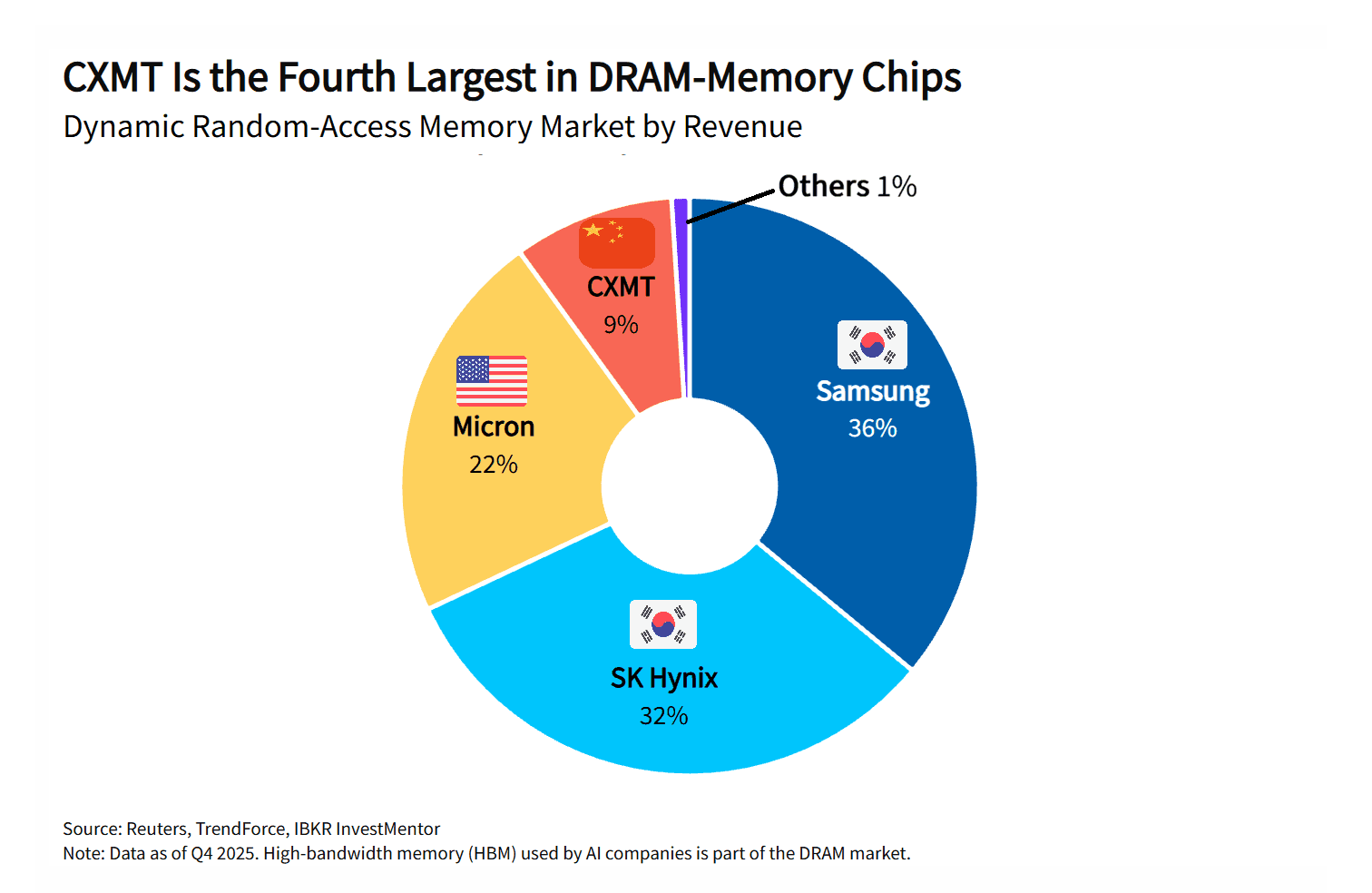
CXMT is the world’s fourth-largest memory-chip maker with roughly a tenth of the DRAM-memory market. That includes high-bandwidth memory (HBM), which is required for AI chips that Nvidia and Chinese competitors like Huawei make.
The 466% surge was the strongest first-day pop for a Chinese company worth more than $5 billion since the records began in 2006, according to data provider Dealogic. Chinese IPOs are often priced conservatively on purpose to ensure a successful-looking debut. Companies leave room for shares to surge, even if it means raising less money during the IPO. CXMT raised $8.5 billion.
China's stock market is also dominated by retail investors — non-professionals — who drive about 90% of the trading volumes on an average day. This can make sentiment-driven rallies much more dramatic. In comparison, only about 20% of the US trading volumes come from retail investors.
Investors also faced a shortage problem: only 6.7% of CXMT's shares were freely tradable on day one. When lots of people want to buy but relatively few shares are available, prices can shoot up.
CXMT story is anchored in geopolitics. Beijing is pouring resources into building a domestic chip industry capable of surviving US export restrictions, and those investments are starting to bear fruit. Memory chips are a critical piece of that puzzle.
The Hefei-based company grew with support from local authorities, including financing, land, and efforts to build a wider semiconductor ecosystem around it. China is not allowed to buy Nvidia's most advanced AI chips, so it’s hoping Huawei can develop them. Meanwhile, Chinese AI models like DeepSeek-V4 and Kimi K3 are matching or surpassing Western competitors by some metrics.
When Chinese retail investors flock to buy a piece of CXMT, they’re also buying into China's ambition to build a self-sufficient AI supply chain.

Even as CXMT exploded higher, investors have been selling established memory leaders Micron, Samsung Electronics, and SK Hynix amid concerns that AI excitement may have pushed chip valuations too far. Just a couple of weeks ago, SK Hynix raised $26.5 billion in the largest-ever secondary US listing. The company has since lost 17% of its value. Over the course of a month, SK Hynix is down 30%, and Micron and Samsung around 20%.
Risks these companies face:
Some are convinced CXMT is still undervalued. Japanese bank Nomura expects the stock to hit 116 yuan within the next 12 months, a nearly 140% rise.
Want to explore more? Download our free app to unlock expert news updates and interactive lessons about the financial world.