Commodities
Back to the 70s
“The Largest Energy Crisis Ever” Could End in an Oil Glut
6/19/2026
6/23/2026

Ten years after the vote to leave the European Union, Britain is in a long, grinding economic slump. The Brexit UK has had weak growth, sticky inflation, jittery bond markets, and a revolving door on Downing Street.
At the start of the anniversary week, Labour’s Keir Starmer became the latest prime minister to call it quits. That means the UK is heading for its seventh prime minister since the 2016 referendum. Former Manchester Mayor Andy Burnham is set to be the next in line for Britain’s toughest job.
Burnham is widely the favorite to take over the Labour Party and the premiership, which is why the bond markets are fixated on his stance on the economy.
Last year — when he was already considered the potential next PM — Burnham said: “We’ve got to get beyond this thing of being in hock to the bond market.”
This was enough to send the bond yields up, forcing him to backtrack. Why? Because gilt investors dislike the idea of a profligate leader who overlooks fiscal rules. This famously got one of the six former Brexit PMs, Liz Truss, into trouble. Her unfunded tax cuts triggered a gilt market rout, forcing the Bank of England to intervene and ending her premiership within weeks.
The UK economy has underperformed since 2016, ranking the second-bottom of the G7 countries for growth per person, ahead of only Germany. A new Bank of England study estimates that the UK has lost 6% of GDP growth due to Brexit.
The BoE governor Andrew Bailey put it plainly: “If you reduce the size of the markets that we trade with, so we reduce our export markets, then that does tend to have a negative impact on growth.”
Business investment has been low, inching only 12% higher than in mid-2016. The US, on the other hand, has climbed 49% in a decade. A decade of policy uncertainty and new trade barriers have delayed investment decisions.
Inflation fears were not on the agenda when Leave and Remain campaigners were exchanging barbs back in 2016. Yet, the UK consumer prices are up nearly 42% since the referendum.
Yes, inflation hit the world hard after the pandemic, but the British numbers are still unusually high. Only Austria surpasses it amongst Western European countries.
The pound is still about 10% weaker against the dollar and euro than before the vote. That raises the cost of imports across energy, food, and goods.
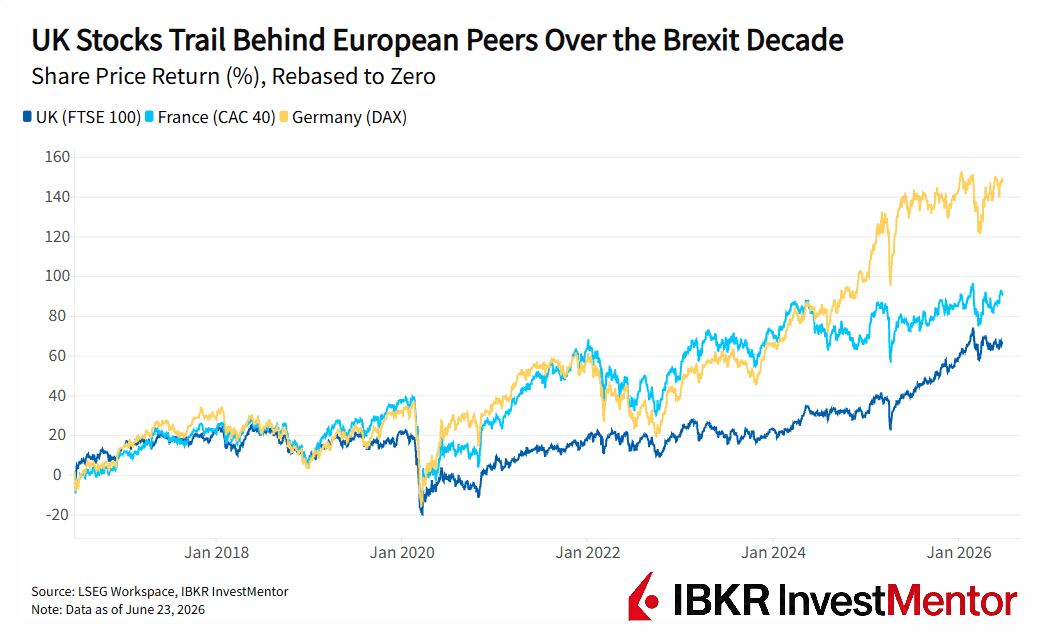
In 2015, UK financial services exports exceeded those of France, Germany, Ireland, the Netherlands, and Italy combined. By 2024, those EU countries together had overtaken the UK. London remains Europe’s largest financial center, but its dominance is teetering.
According to research company New Financial, between 2015 and 2025:
The UK stock market has also underperformed. Even the blue-chip index FTSE 100, stacked with the biggest British companies, is lagging behind the French and German indices. In mid-sized companies, the gap is even more prominent, with the UK stocks actually losing value over the decade.